Bittensor is a network where separate projects, called subnets, compete for a share of a daily payout. That payout is the main income most of these projects have. Between 3 and 13 August the rules deciding who gets what were changed five times. This is what changed, in plain words, and what it could mean.
A quick note on one word you will see throughout. Emissions simply means the new TAO the network creates and hands out every day. When a subnet gets a bigger share of emissions, it is getting paid more.
Your staking rewards now go through a fund
If you stake TAO at the top level of the network, called root, your rewards used to come straight back to you. Since 3 August they do not. They now go into a fund attached to whichever validator you staked with. The network calls these funds baskets. A validator is simply an operator who helps run the network and decides which projects to support.
Each validator has one basket, and the money inside gets spread across subnets according to that validator's own preferences. So your rewards are now being invested on your behalf, by the operator you picked, into the projects they favour.
One detail is worth knowing if you are ever putting money in. When you deposit, you get shares priced at what the fund was worth before your money arrived. That means someone joining later cannot water down what you already own. Being early is protected on purpose.
Why this matters to you: if you stake at root level, you no longer choose where your rewards go. Your validator does. Their preferences were always public but they used to be a technical detail. Now they decide where a large stream of money lands, so they are worth looking at.
A loophole was paying people 40,000 percent a year
The fund change shipped with a mistake in the maths. If a validator held TAO at root level but was not properly registered there, the calculation credited its entire reward as if it had been earned on a subnet instead.
The result, in the developers' own numbers: operators holding a tiny amount of one subnet's tokens, alongside about 4,000 TAO, were showing annual returns between 7,000 and 40,000 percent.
Those returns were never real. They were an accounting error. But the money that chased them was real, and it went into whichever subnets those operators were attached to. The fix, shipped a day later, says plainly that its purpose is to end the practice of pulling people onto subnets using rewards that were never genuinely earned.
Why this matters to you: some subnets have been attracting deposits for a reason that no longer exists. If a project looked unusually popular over the past couple of weeks, this could be why, and that support may not stay.
The rule that pays everyone was changed, then changed back
On 10 August the network removed a factor from the formula that decides each subnet's share of the daily payout. On 12 August it put the factor back.
The factor in question reduces a subnet's share if that subnet holds back rewards from its own workers rather than paying them out. Removing it made shares depend purely on price. Restoring it means holding back worker pay costs you network-wide income again.
Separately, a feature launched days earlier, letting people deposit directly into those new validator funds, was switched off while the team reviews how much storage it consumes.
Why this matters to you: the rules governing everyone's income were reversed inside 48 hours, and a brand new feature was disabled almost immediately. This is not a settled system. Anything you decide based on today's exact numbers is worth checking again in a week.
How the top 32 really works
You will hear that only the top 32 subnets get paid. That is close, but the shorthand hides the part that actually matters, and the real mechanism is in the network's source code.
There is a moving line, which the code calls a bar. It is positioned so that exactly 32 subnets sit at or above it. That is where the number 32 comes from, and it is correct.
But crossing that line does not simply switch your income on. Instead, every subnet's share gets multiplied by a number between zero and one, based on how far above or below the line it sits. A subnet sitting exactly on the line, at rank 32, keeps half of what it would otherwise earn. Not all of it. Half.
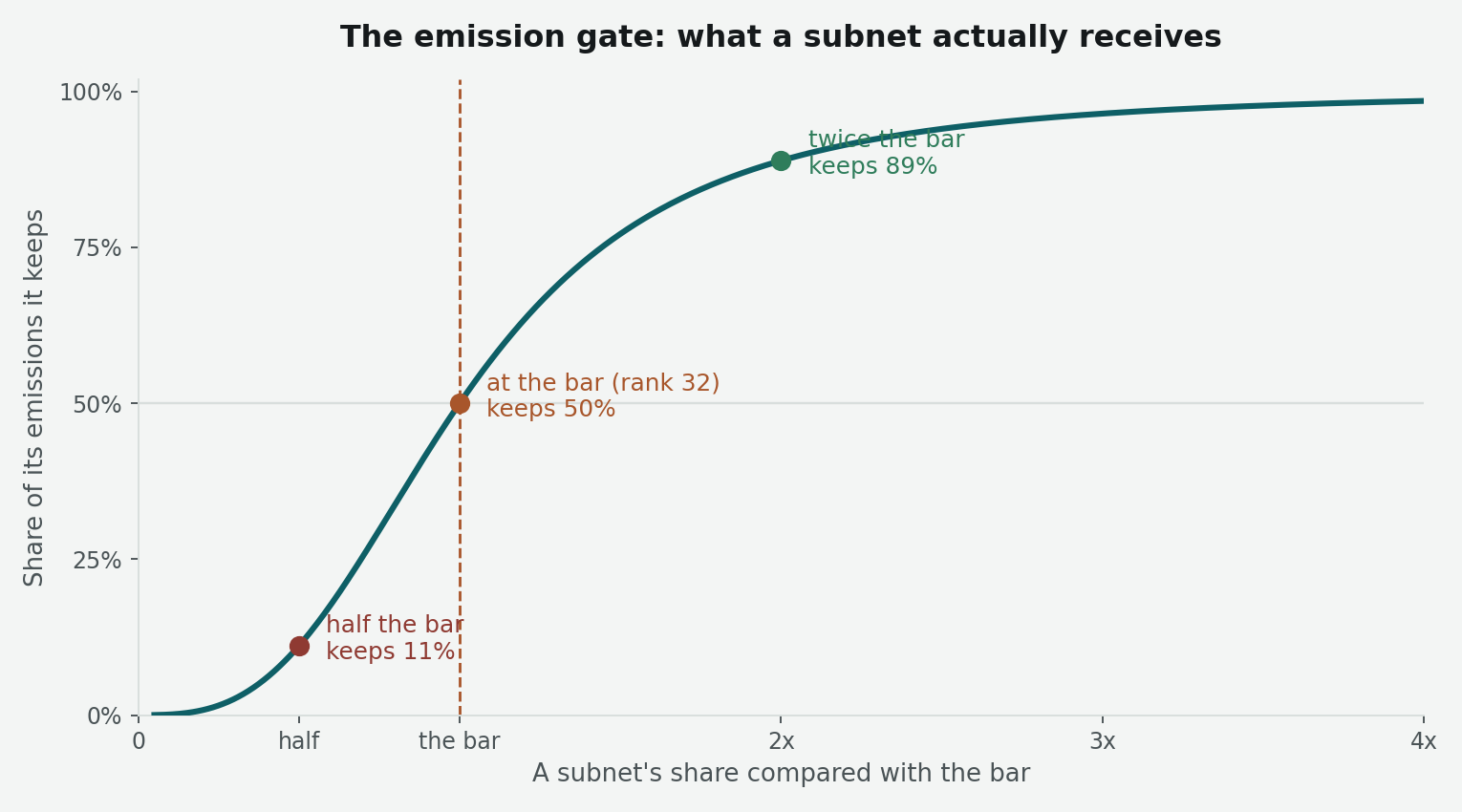
Here is what that multiplier looks like at different positions:
- Four times above the line: keeps 98.5 percent
- Twice above the line: keeps 88.9 percent
- Exactly on the line, rank 32: keeps 50 percent
- A quarter below the line: keeps 29.7 percent
- Half the line: keeps 11.1 percent
- A quarter of the line: keeps 1.5 percent
Notice where the pain is. It is not at rank 32. Going from the line down to half the line takes you from 50 percent to 11 percent, so you lose nearly four fifths of your income for halving your position. That cliff sits well below the famous cutoff.
The part almost everyone misses
Here is the piece that changes how you should read all of this.
The income taken off the subnets below the line does not disappear. After the network applies that multiplier to everyone, it adds all the shares back up and divides them out again so they total 100 percent. In other words, whatever gets taken from the bottom is handed round to everyone still standing.
A worked example makes it obvious. Imagine three subnets. One is well above the line and would earn 60 percent of the payout on price alone. One sits exactly on the line and would earn 30 percent. One is below the line and would earn 10 percent.
After the multiplier is applied and the total is shared out again:
- The one above the line goes from 60 percent to 77.6 percent
- The one on the line goes from 30 percent to 21.8 percent
- The one below goes from 10 percent to 0.5 percent
The subnet above the line did nothing. Its price did not move. It gained a third more income purely because the subnets below it were penalised and the leftovers were shared out.
So this is not a discount system. It is a transfer. Subnets below the line are funding the subnets above them.
That is what makes climbing so valuable. A subnet crossing the line does not just start being paid properly, it stops being the one paying. It switches from donor to recipient. That is why the jump from below the line to above it multiplies a project's income roughly eightfold, while climbing from twice the line to four times only adds about a tenth. The reward is for crossing, not for climbing higher afterwards.
Two smaller details, both from the code. The line only recalculates about every 72 minutes, deliberately, so a brief dip in price cannot knock a project out at the boundary. And subnets with no activity are ignored when the line is set, so nobody can move it by registering empty ones.
Which subnets are actually earning money
Against that background, the week's project news divides into evidence you can check and claims you cannot.
The strongest kind of evidence is a project using real income to buy its own token back on the open market, because those purchases are recorded permanently and anyone can go and look. Three did so this week. Engy, subnet 53, reported that money from customers using its service funded two buybacks totalling about 7,354 dollars. Bitcast, subnet 93, reported roughly 33,000 dollars of buybacks last month and rising. Lium, subnet 51, is described as regularly running six figure buybacks.
On partnerships, Siam Kidd published a summary on 7 August: Targon, subnet 4, working with Intel. Score, subnet 44, working with a company listed on the NASDAQ stock exchange. Leadpoet, subnet 71, working with Dropbox. Zeus, subnet 18, taking on large institutional clients. Minos, subnet 107, co-writing research with OpenAI. Actual, subnet 95, built into a product called Hermes. Actual also joined Nvidia's Inception programme in July.
Leadpoet won best product at the OKX Genesis Hackathon this week. Chutes, subnet 64, released a document reading tool on 12 August.
A partnership with a company like Intel or Dropbox usually implies money is changing hands, whether or not anyone uses the word revenue. Those companies do not sign agreements with projects that have nothing to sell.